Feb 2026 · 24 hours
The future of AI in wearables
Creating wearable intelligence in 24 hours
- Context & Problem
- AI assistants wait to be asked. Wearables have solved the form factor but not the thinking layer, so intelligence stays a tool you have to remember to reach for.
- Assistants that wait to be asked aren’t intelligent. They’re on standby.
- Role & Constraints
- Product and brand designer in a team of four, in 24 hours. I owned the signal-based visual system that keeps the centre of vision clear, and co-designed the airport and gym scenarios.
- Outcome & Impact
- 1st place at the Designpreneurs AI & Startup Design Hackathon (Parsons x University of Arizona).
Overview
Iris was built at the Parsons x University of Arizona 24-hour AI Hackathon, hosted by Designpreneurs. The question on the table: what does technology look like in 2036? We explored how AI and wearables could shape the way intelligence fits into our lives, and Iris was the answer we came up with.
The Problem
AI is everywhere, and still waiting to be asked.
We began by auditing current AI tools and understanding the wearables space:
- Current AI tools are largely reactive. They wait for a prompt, and they rarely understand the full context of the problem you want them to solve.
- Users rely on multiple tools to solve a single problem, since apps often only solve one thing at a time.
- Wearables get AI out of the screen and into the world, which is exciting, but they’re still running on shallow intelligence and interfaces that aren’t there yet. The form factor is solved. The thinking layer isn’t.

Research
Everyone in the space was racing to build a smarter assistant: better answers, faster recall, a nicer chat on your face. But the bottleneck was never the answers. It was the asking. As long as intelligence waits to be summoned, it stays a tool you have to remember to reach for.
So we bet on the opposite: an agent that reads the moment and acts before you think to prompt it: context replacing commands. Presence, not response.
The Solution
An agent that reads the moment instead of waiting to be summoned.
We imagined something different: Iris. An agentic AI platform for smart glasses that doesn’t wait for a prompt. It learns how you live, reads the moment, and shows up before you ask. Not a chatbot on your face, a discrete personal agent that builds context over time, asks the right questions, and shapes itself around you.
Because your phone isn’t always in your hand, but your eyes are always open. Smart glasses give AI continuous access to what you’re seeing, without pulling you out of the moment. No tapping, no waking a screen. Just presence.
Design Process
To make this real, we followed one person through their day.
He’s at the airport, moving fast, already mentally checked out. Iris finds the gate and clocks the timing before he even thinks to look. When he lands, it steers him straight to the right baggage carousel. No searching, no friction. Just the next step, right when he needs it.
At the gym, Iris shifts with him. It tracks his reps, sets, and progress in real time, and when he’s ready for the next movement, it points him to the right machine. No app to open, no screen to check. Iris just keeps up.
Building the Visual Identity
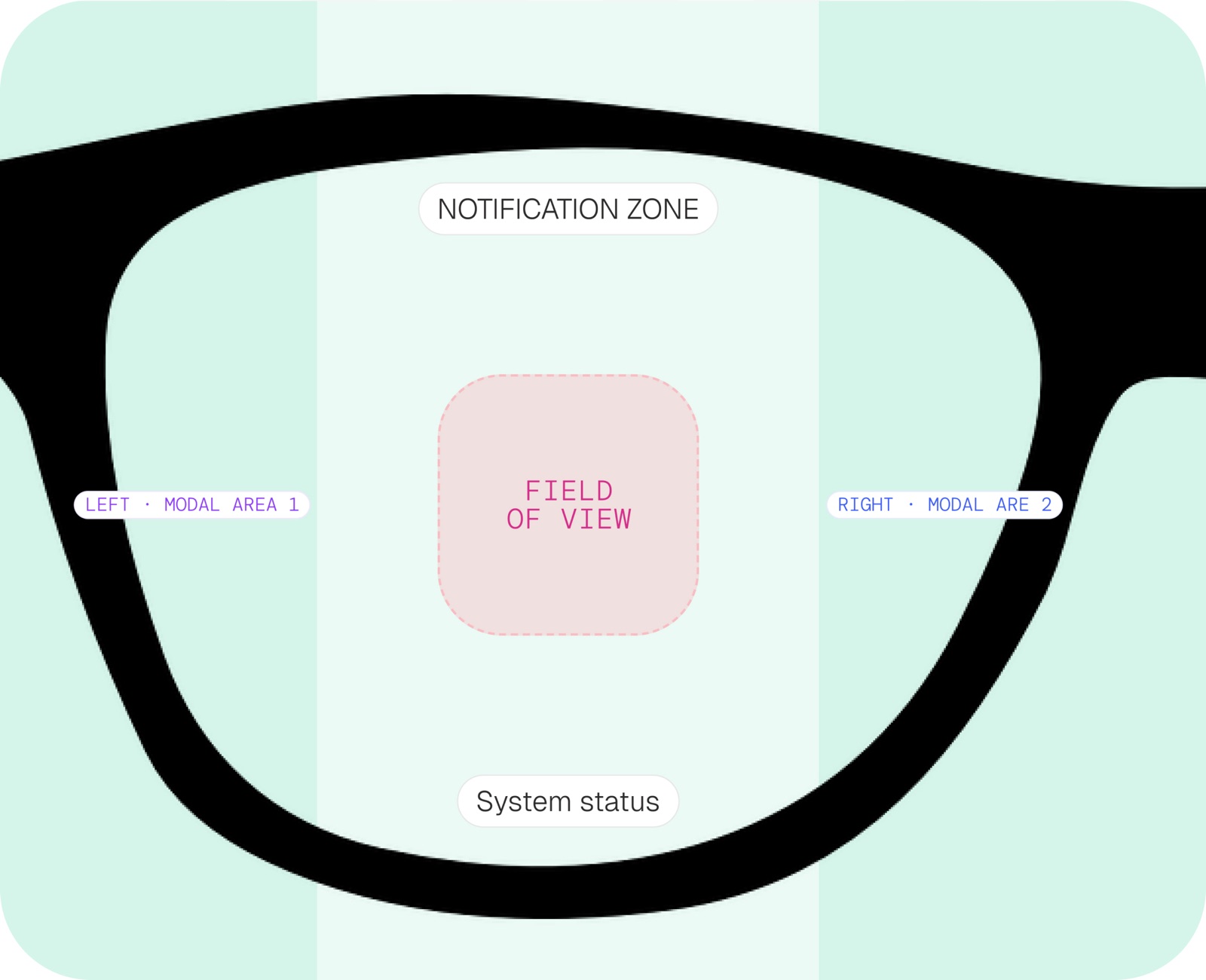
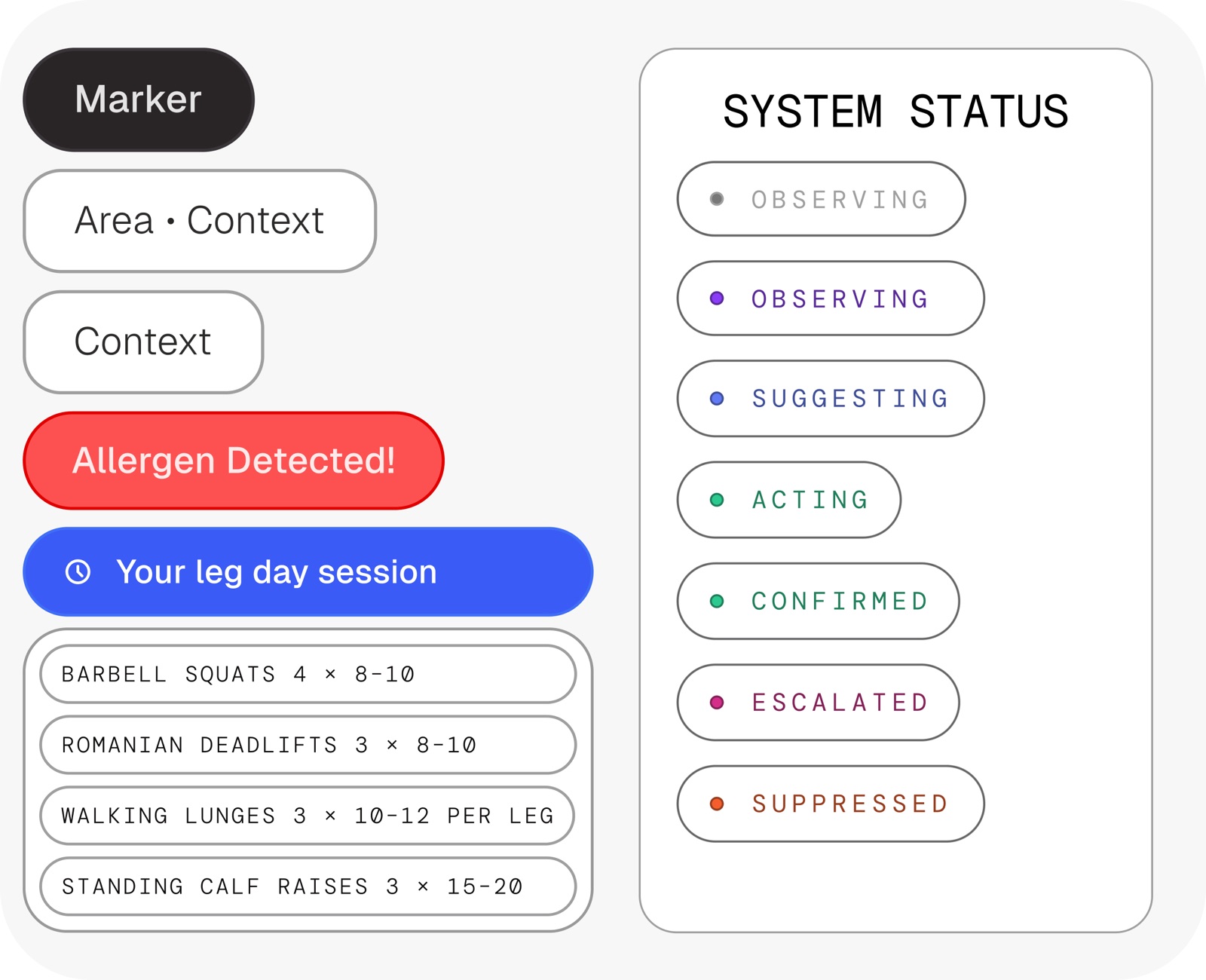
Iris organizes information into distinct visual zones: urgency and relevance determine what appears and where, while the center stays completely clear. Your vision stays yours. The design system itself is intentionally stripped back. Simple shapes, bold colors, signal-based elements. Enough to communicate, never enough to crowd.

Results
A bet on where intelligent interfaces are heading next.
Iris is a bet on intentional design, and on a shift that’s already underway. Moving from reactive, chat-based AI to something longitudinal, something that lives with you, is the next big category of intelligent interfaces. We built Iris to help define what that looks like.
Iris took First Place!
Iris took first place at the AI & Startup Design Hackathon hosted by Designpreneurs, a 24-hour sprint bringing together students from Parsons School of Design and the University of Arizona. Special thanks to my team!